Work 05 2020 — 2021 Self-set brief

Nexus

The problem lives between portals, so I designed an extension that follows the candidate to any careers page and a portal that remembers.

My job was to design an employment portal, and the browser extension turned out to be the product.

The before, drawn: six columns headed as job portals, each holding the same eleven rows: name, email, phone, two address lines, city, postal code, country, and two degrees with their dates. A spreadsheet of applied dates is ruled along the foot.
six destinations, one candidate eleven fields, every single time a spreadsheet, kept by hand
Before The before, drawn: six columns headed as job portals, each holding the same eleven rows: name, email, phone, two address lines, city, postal code, country, and two degrees with their dates. A spreadsheet of applied dates is ruled along the foot.
Role
Self-set brief
Year
2020 — 2021
Kind
Concept
Code
P–002

01

People were not lost in one portal, they were lost between all of them

I set this brief myself in December 2020, with no client and nobody waiting for it. The research was interviews, a survey and a read of what the other portals were doing; I did not keep the counts. Four things came back often enough to design against, and not one of them was about a single portal being bad.

What they said, and what answered it
People lost track of what they had applied to across portals.
A list that records the applications sent from other people’s sites, beside the ones sent from here.
Applications
People doubted whether a posting was real, current, or from the company at all.
The source printed on every card, and a route to the company’s own careers page.
Explore jobs
People skipped jobs they were suited for because the form was long.
A panel on the form itself, offering the answers the profile already holds.
The extension
Résumés say what you did, and then stop.
A profile with room for work, for interests, and for a written answer to who you are.
Profile

02

The portal sends the candidate away from itself, and says so on the card

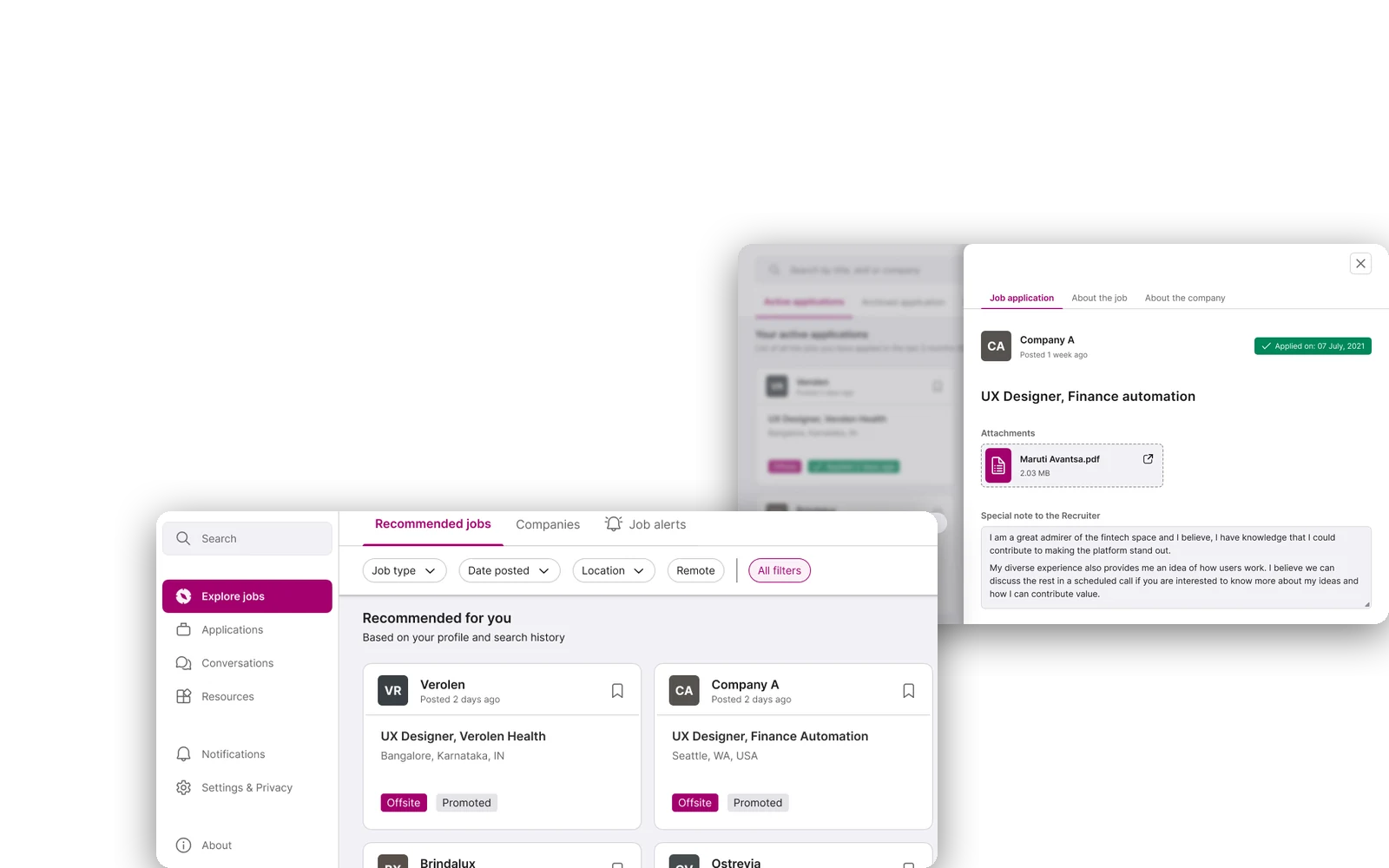
Explore lists jobs the portal holds and jobs it does not, and marks the second kind Offsite. Tapping an offsite card sends the candidate to the company’s own careers page, which is where they said they wanted to go. Applications then keeps the record that careers page never gives back: ninety days of what you applied to, wherever you applied.

Two screens set side by side: a three-column grid of job cards, each with a letter mark, a company name, a role and a small status pill, and a list of applications with applied-on dates and one detail drawer open on the right.
Offsite: this one lives on the company’s site where the posting came from, on every card applied on 07 July, recorded from elsewhere ninety days here, older ones archived
Explore and Applications, recomposed from the 2021 screens. Every company on them is invented and wears a drawn letter mark.

03

The profile answers who the candidate is, which a résumé cannot

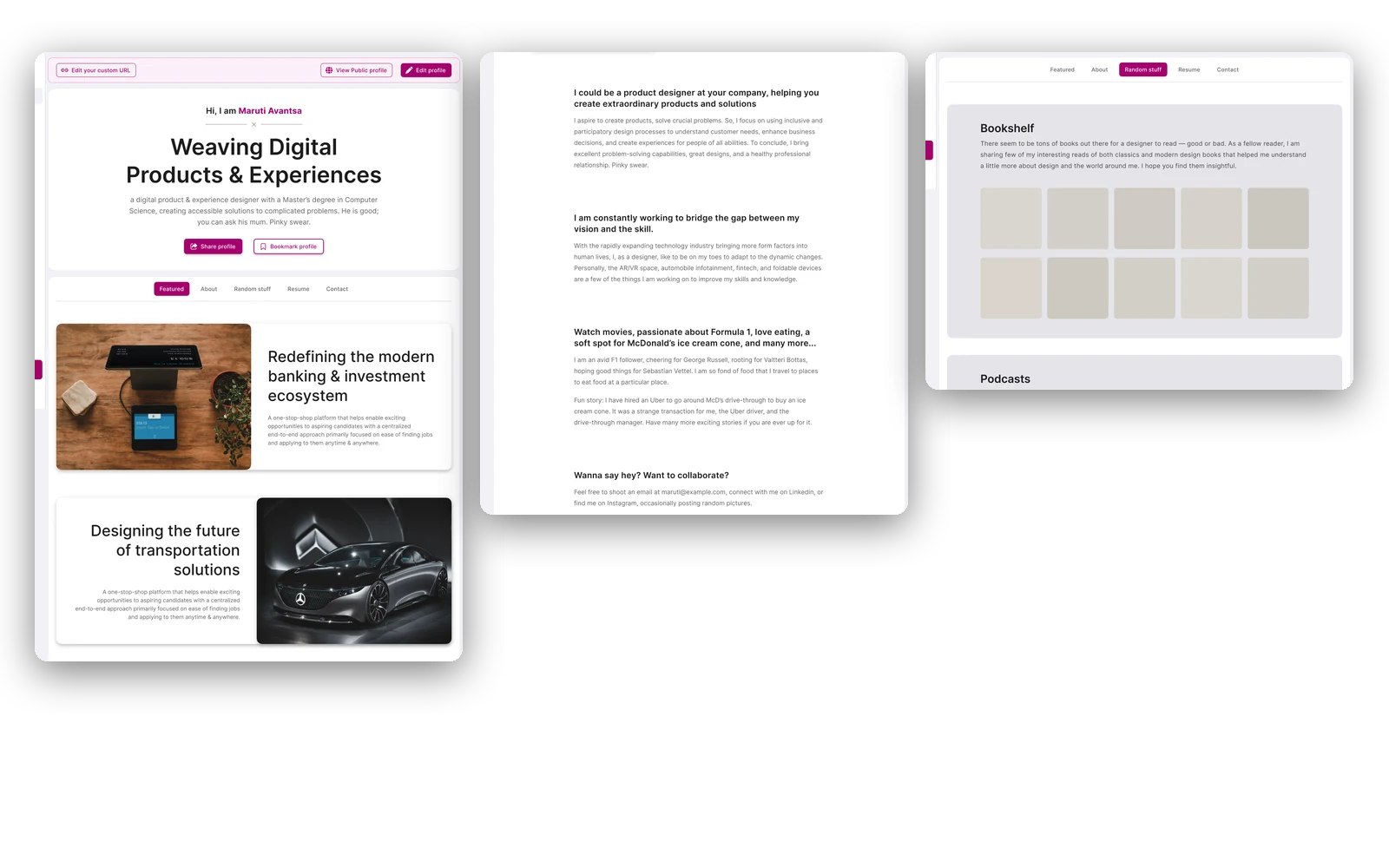
A résumé tells an employer what you have done and stays silent about the rest. Three of its four tabs answer that; the fourth held the résumé, and I have left it off this page. Featured holds two or three pieces of work, About is a written answer to who you are, and Random stuff is what you read and listen to.

Three profile tabs composed together: a headline over three featured work cards, an about tab of four short written answers under bold prompts, and two rows of blank book and podcast covers.
Featured, About and Random stuff from the 2021 screens. The photographs, the covers and the contact details are replaced with drawn placeholders.

04

The extension fills the form, and the candidate decides what goes in

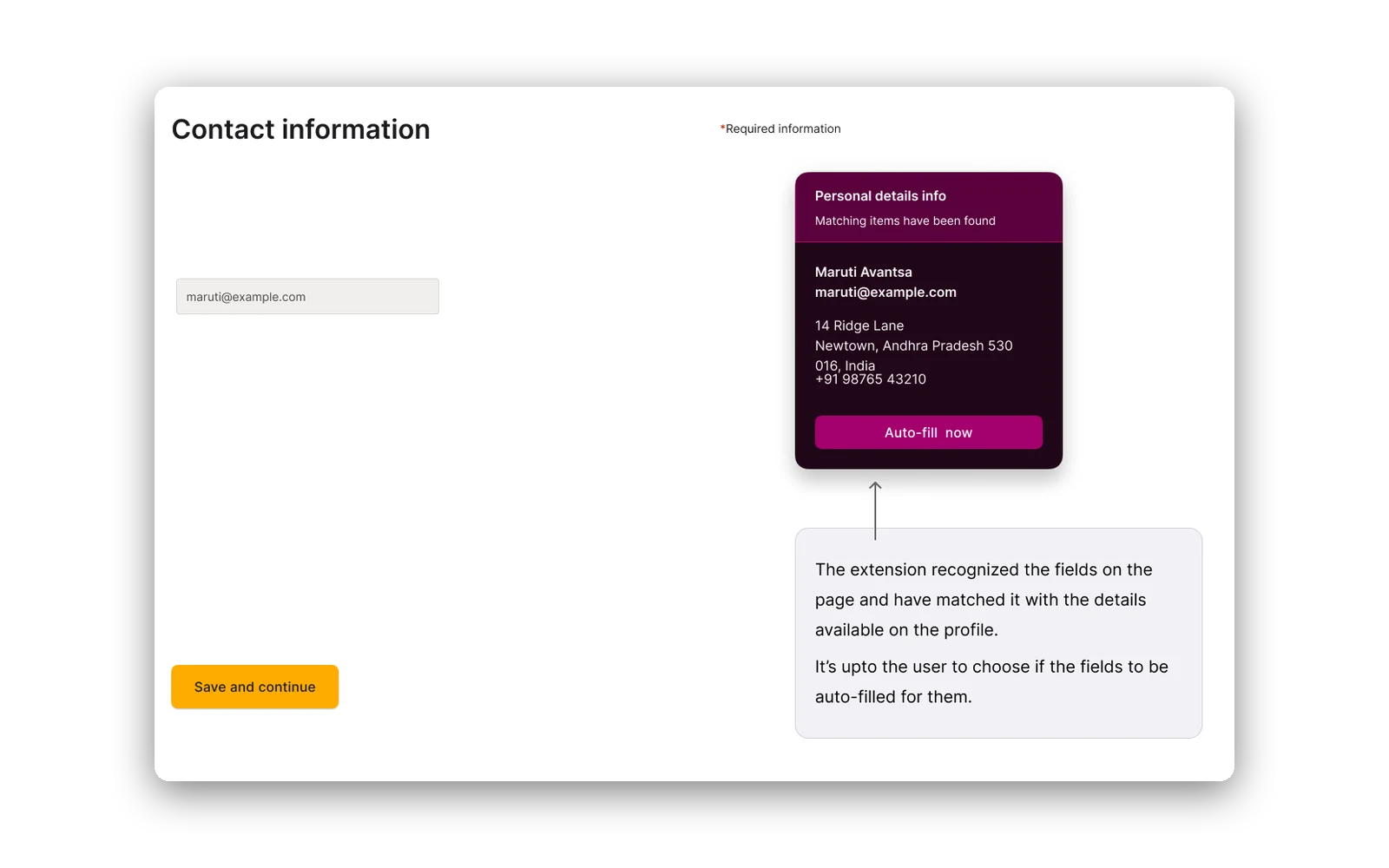
The deck called the extension the heart of the product and then gave it the shortest section in the deck. It is the only part that runs on another company’s website: a panel on their apply form, offering what the profile already holds. It never writes a field on its own, and it asks differently when it finds one record than when it finds several.

A drawn apply form with the panel on it. One click fills the contact details; the education step finds two records and waits to be told which.
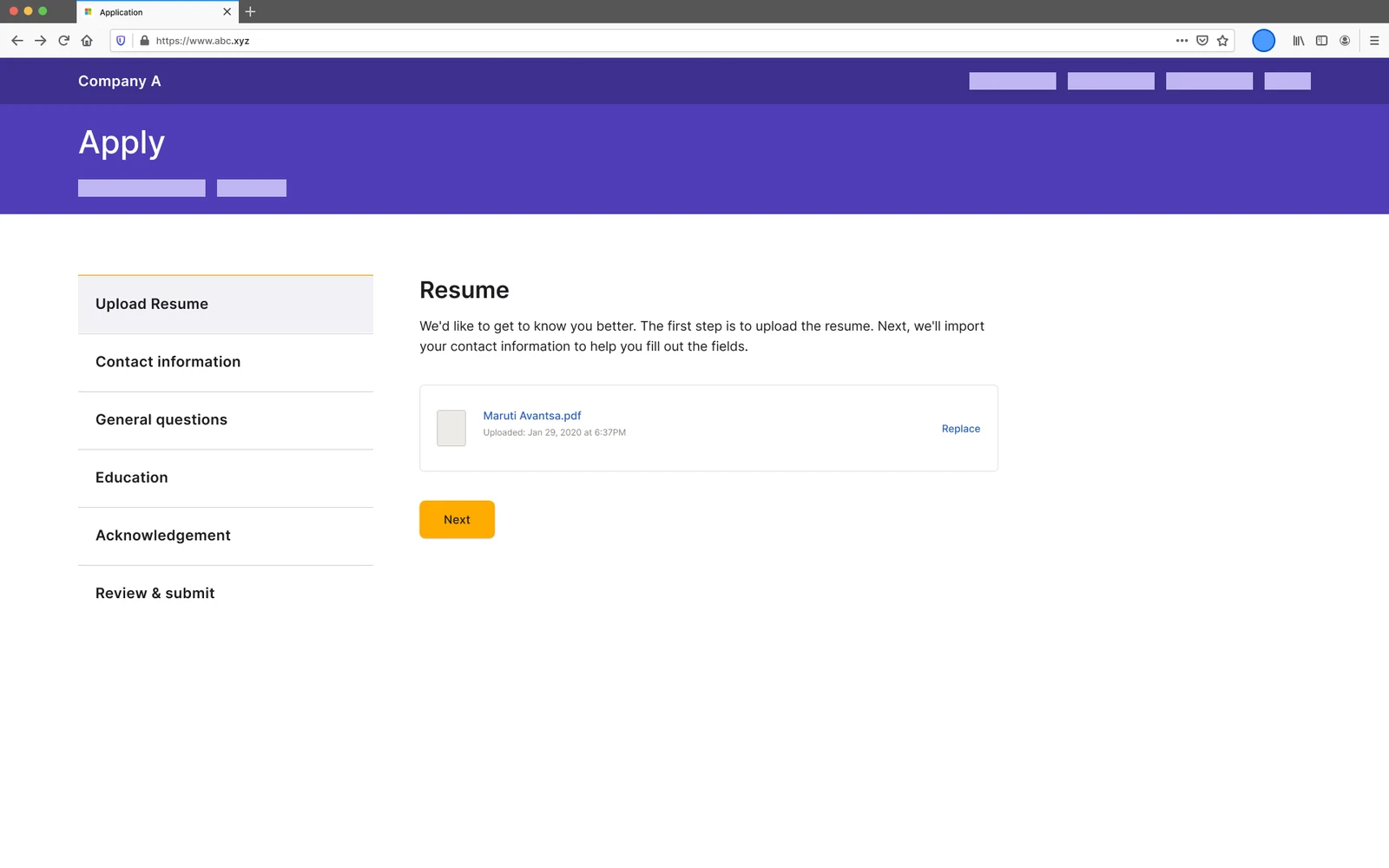
A six-step apply form on a plain careers site, open on its first step, with one uploaded résumé file listed and the rest of the form untouched.

UPLOAD RÉSUMÉ Company A’s apply form opens on a résumé upload, and the panel stays shut.

1 / 10

The 2021 extension flow, stepped frame by frame against a generic careers site called Company A. Every name, address, date and employer on it is invented.

05

Picking it up again means the software reads the form, and the candidate still decides

Version 1 paused in 2021 and none of what follows is built; these are the intentions I am picking it up with. The 2020 flow only ever ran against one mock form, and I never worked out how it would read a form it had not seen. A model that reads a form the way a person does takes that limit off, and the rest of this list is what I would refuse to change.

The 2020 element, the move, and the line that stays

The panel was drawn against one mock form; reading a form it had not seen was never worked out.
A model reads any apply form the way a person does, so the extension works on a company’s own form with nothing taught to it first.
The match is a proposal; the candidate still clicks.
General questions were typed by hand, and the panel kept away from prose.
The agent drafts an answer in the candidate’s own words, out of the profile, and hands it over to be edited.
Facts get filled. Words only get proposed.
One link for the recruiter, in place of a résumé.
The profile becomes a record the candidate owns, in a shape any other tool can read once it is given permission.
The candidate decides who reads it, each time.
Applications logged what was submitted and tagged it Offsite.
The agent keeps watching after the submission, so status changes and recruiter replies arrive in the list on their own.
The record names every field the agent filled.
Apply now was one button on every card.
The agent reads the posting against the profile and says plainly where the gaps are, before the candidate spends an hour on the form.
No bulk mode, and no applying without a person.
The 2020 design never said what the receiving site would be told.
The extension says what it is to the site receiving the form, and asks to be trusted on that.
An employer sees that a person applied, and what helped them.
The extension’s panel standing over an empty apply form on a generic careers site: a heading reading matching items have been found, four rows holding a name, an email, an address and a phone number, and one button under them.
After

Concept work, set as my own brief in December 2020 and published on Behance in July 2021. Nobody used it, so there are no numbers on this page. The research was interviews, a survey and a read of the competitors; I did not keep the counts, and the statistics in the original deck are other people’s, so they are off. Every company and every person here is invented and wears a drawn mark, and the candidate’s contact details are made up. The four observations in chapter one and one line each in chapters three and four are paraphrased from the original deck. The last chapter is intentions, not work.